Kyoritsu · KEW 1019R
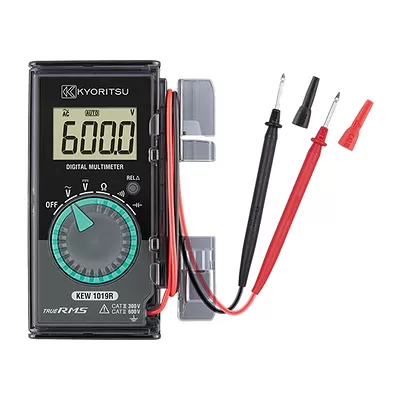
Kyoritsu KEW 1019R True RMS Digital Multimeter
Slim True RMS digital multimeter for AC/DC voltage, resistance, continuity and capacitance, supplied in a…
List price ₹10,859 30% OFF
₹7,601 + GST
You save ₹3,258
A digital multimeter is the first instrument most electricians and technicians reach for. It measures voltage, resistance and continuity, and most models add current, capacitance, frequency or diode test.
Kyoritsu multimeters range from a 100 g pen-type meter to high-accuracy industrial models rated CAT IV 600 V / CAT III 1000 V. Use the filters to narrow by type, or read the buying guide below.
Kyoritsu · KEW 1019R
Slim True RMS digital multimeter for AC/DC voltage, resistance, continuity and capacitance, supplied in a…
Kyoritsu · KEW 1021R
True RMS 6000-count multimeter rated CAT IV 300 V, with 10 A current ranges and an input for Kyoritsu clamp…
Kyoritsu · KEW 1051
High-accuracy True RMS multimeter (0.09% basic DC V) rated CAT IV 600 V / CAT III 1000 V, with a low-pass…
Kyoritsu · MODEL 1009
General-purpose 3999-count multimeter with direct AC/DC current up to 10 A, frequency, duty cycle, diode and…
Kyoritsu · KEW 1030
Pen-type 100 g multimeter with a built-in penlight and backlit display for voltage, resistance, capacitance…
Measurement category (CAT rating). The CAT rating tells you where the meter may be used safely. CAT II covers equipment plugged into sockets; CAT III covers fixed installations such as distribution boards; CAT IV covers the origin of the installation, such as the supply side of the main breaker and outdoor service cables. Always choose a meter rated for the highest category and voltage you will work on.
True RMS. Loads such as drives, LED drivers and computers distort the current and voltage waveforms. A True RMS meter reads these correctly; an average-responding meter can read low. For industrial and commercial work, True RMS is the safer choice.
Current measurement. Some meters, such as the KEW 1019R and KEW 1030, have no current ranges. Others measure up to 10 A directly through fused inputs. For higher currents, use a clamp meter or a meter with a clamp-sensor input such as the KEW 1021R.
Extra functions. Capacitance, frequency, duty cycle, temperature and a low-pass filter for motor drives are useful if you work on control circuits, HVAC or variable-speed drives.
CAT III covers fixed installations inside a building, such as distribution boards and fixed wiring. CAT IV covers the source of the installation, such as the service entrance and the supply side of the main breaker. A CAT IV meter is designed to withstand higher transient overvoltages.
If you measure circuits with electronic loads, such as drives, LED lighting or computers, a True RMS meter gives more reliable AC readings. For simple resistive loads an average-responding meter is usually adequate.
Most multimeters measure up to 10 A directly. For higher currents use a clamp meter, or a multimeter with a clamp-sensor input used with a compatible Kyoritsu clamp sensor.
Looking for another brand of digital multimeter? Our multi-brand site IndiaMeters covers other manufacturers.